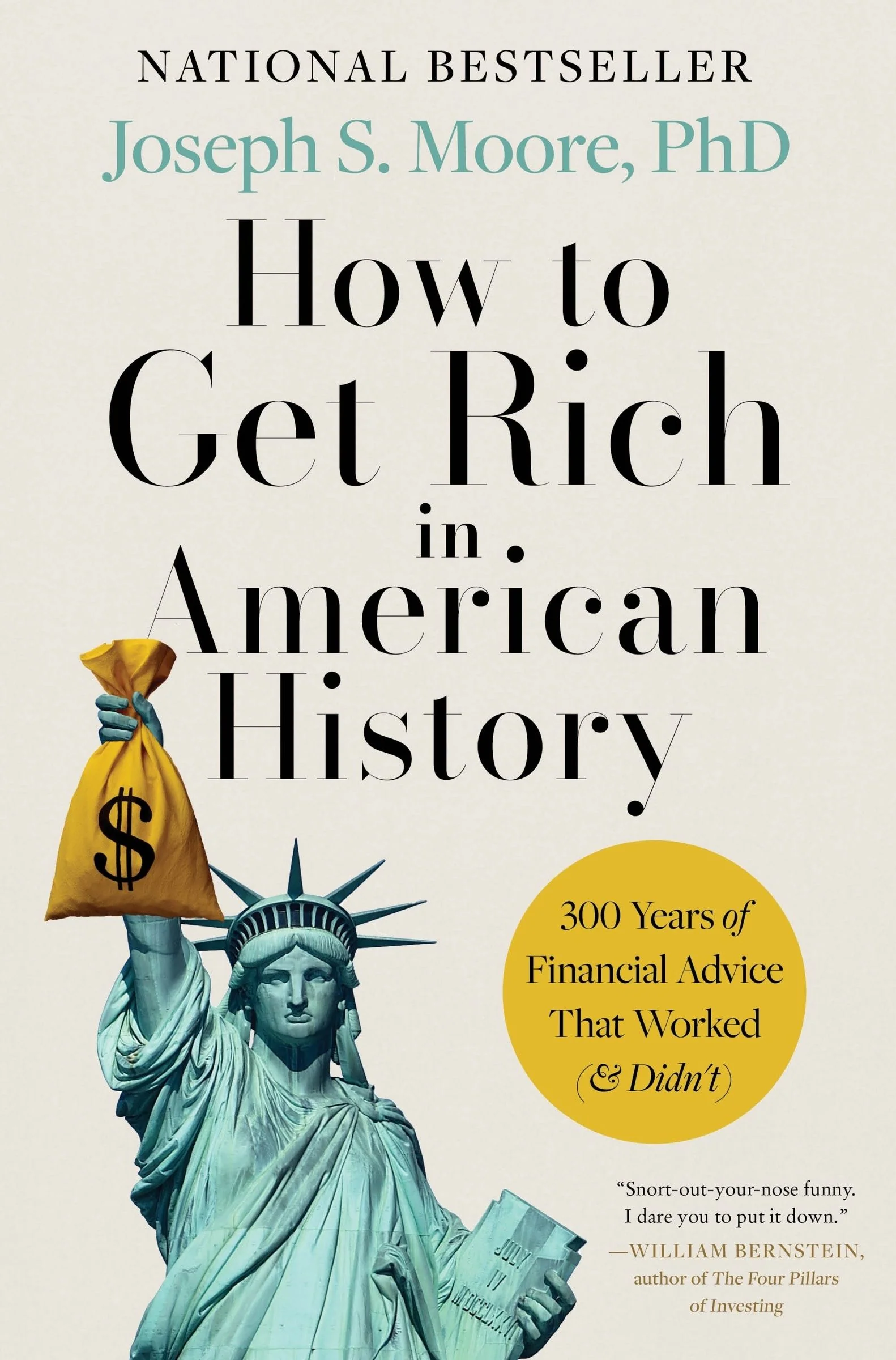
How to Get Rich in American History
A Next Big Idea Club Must-Read
“Eye opening, deeply researched, and snort-out-your-nose funny. I dare you to put it down.” —William Bernstein, author of The Four Pillars of Investing
“Refreshingly unequivocal advice.” —Publishers Weekly
In richly told stories and wild self-experiments, historian Joseph Moore tests history’s best and worst financial advice to find what worked, what didn’t, and why everyday people can still get ahead—including you.
What if so-called timeless beliefs about money like “invest for the long run,” “compound interest builds wealth,” and “real estate always goes up” were shockingly new . . . and rarely true.
From Benjamin Franklin to TikTok gurus, what “everyone knows” about personal finance has rarely stayed the same. Parents once taught children not to save and that stocks were only for suckers. Meanwhile, supposedly new phenomenon like Airbnb, crypto, skipping lattes, and complaints that nobody can get ahead are far older than we think.
In How to Get Rich in American History, Joseph Moore shares the unexpected and counterintuitive lessons of the past—from the scams we keep falling for to the long allure of creating generational wealth—so we can avoid the same mistakes and make the most of our own finances today.
Along the way, Moore tries these old ideas on himself, with hair-raising and hilarious results. His personal journey includes wild investments, get-rich-quick schemes, founding a cryptocurrency, and how he went from his working-class roots and facing financial ruin to retiring in his forties. Ultimately, Moore finds that despite today’s loud pessimists, success has never been easier to achieve in American history than it is right now.
Fun, accessible, and filled with eye-opening insights you can apply for yourself alongside laugh-out-loud stories you never learned in school, How to Get Rich in American History pushes back against skeptics who claim the American dream is out of reach. It is a thoughtful, practical, and surprisingly hopeful read that sheds new light on the prospects of getting by and getting ahead then . . . and now.
A Next Big Idea Club Must-Read
“Eye opening, deeply researched, and snort-out-your-nose funny. I dare you to put it down.” —William Bernstein, author of The Four Pillars of Investing
“Refreshingly unequivocal advice.” —Publishers Weekly
In richly told stories and wild self-experiments, historian Joseph Moore tests history’s best and worst financial advice to find what worked, what didn’t, and why everyday people can still get ahead—including you.
What if so-called timeless beliefs about money like “invest for the long run,” “compound interest builds wealth,” and “real estate always goes up” were shockingly new . . . and rarely true.
From Benjamin Franklin to TikTok gurus, what “everyone knows” about personal finance has rarely stayed the same. Parents once taught children not to save and that stocks were only for suckers. Meanwhile, supposedly new phenomenon like Airbnb, crypto, skipping lattes, and complaints that nobody can get ahead are far older than we think.
In How to Get Rich in American History, Joseph Moore shares the unexpected and counterintuitive lessons of the past—from the scams we keep falling for to the long allure of creating generational wealth—so we can avoid the same mistakes and make the most of our own finances today.
Along the way, Moore tries these old ideas on himself, with hair-raising and hilarious results. His personal journey includes wild investments, get-rich-quick schemes, founding a cryptocurrency, and how he went from his working-class roots and facing financial ruin to retiring in his forties. Ultimately, Moore finds that despite today’s loud pessimists, success has never been easier to achieve in American history than it is right now.
Fun, accessible, and filled with eye-opening insights you can apply for yourself alongside laugh-out-loud stories you never learned in school, How to Get Rich in American History pushes back against skeptics who claim the American dream is out of reach. It is a thoughtful, practical, and surprisingly hopeful read that sheds new light on the prospects of getting by and getting ahead then . . . and now.
Original: $14.99
-70%$14.99
$4.50Description
A Next Big Idea Club Must-Read
“Eye opening, deeply researched, and snort-out-your-nose funny. I dare you to put it down.” —William Bernstein, author of The Four Pillars of Investing
“Refreshingly unequivocal advice.” —Publishers Weekly
In richly told stories and wild self-experiments, historian Joseph Moore tests history’s best and worst financial advice to find what worked, what didn’t, and why everyday people can still get ahead—including you.
What if so-called timeless beliefs about money like “invest for the long run,” “compound interest builds wealth,” and “real estate always goes up” were shockingly new . . . and rarely true.
From Benjamin Franklin to TikTok gurus, what “everyone knows” about personal finance has rarely stayed the same. Parents once taught children not to save and that stocks were only for suckers. Meanwhile, supposedly new phenomenon like Airbnb, crypto, skipping lattes, and complaints that nobody can get ahead are far older than we think.
In How to Get Rich in American History, Joseph Moore shares the unexpected and counterintuitive lessons of the past—from the scams we keep falling for to the long allure of creating generational wealth—so we can avoid the same mistakes and make the most of our own finances today.
Along the way, Moore tries these old ideas on himself, with hair-raising and hilarious results. His personal journey includes wild investments, get-rich-quick schemes, founding a cryptocurrency, and how he went from his working-class roots and facing financial ruin to retiring in his forties. Ultimately, Moore finds that despite today’s loud pessimists, success has never been easier to achieve in American history than it is right now.
Fun, accessible, and filled with eye-opening insights you can apply for yourself alongside laugh-out-loud stories you never learned in school, How to Get Rich in American History pushes back against skeptics who claim the American dream is out of reach. It is a thoughtful, practical, and surprisingly hopeful read that sheds new light on the prospects of getting by and getting ahead then . . . and now.