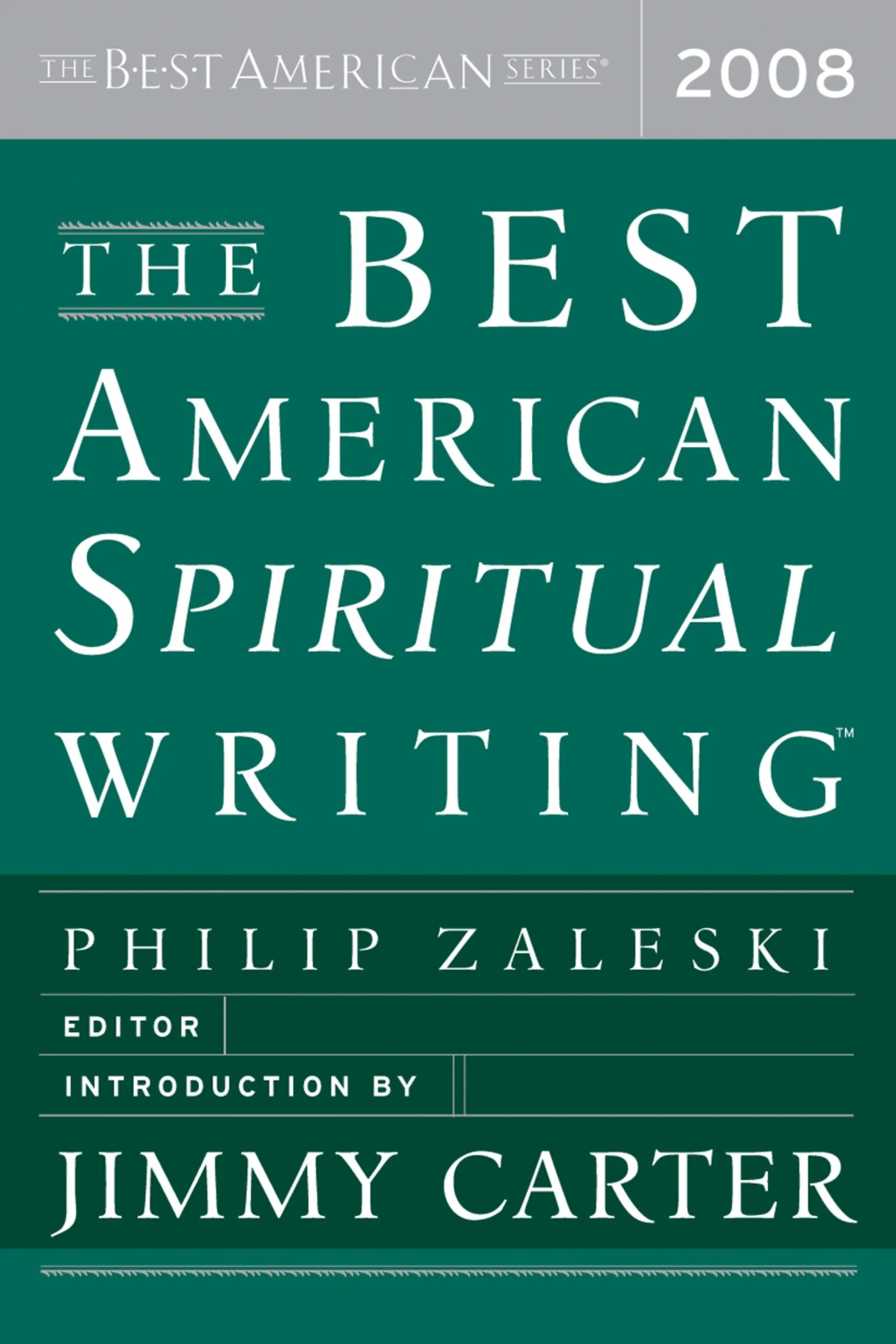
The Best American Spiritual Writing 2008
In his introduction to this volume, President Jimmy Carter writes that The Best American Spiritual Writing “approaches the writing of both poetry and prose as a spiritual discipline, a way to explore the mysteries of the soul and the soul’s relationship with God.” As always, editor Philip Zaleski has assembled a wide-ranging and wonderfully eclectic collection that delves headlong into that spiritual discipline, looking to inspire, provoke, and offer insight into modern spirituality and religion.
Here you will find Walter Isaacson’s brilliant and provocative portrait of Einstein’s religious life—a cross between his parents’ secularism, his native Judaism, and his Catholic grade-school education. Drawing from his own experience of trying to inhabit multiple worlds, Noah Feldman examines the difficulties facing faith communities as they adhere to tradition yet also strive to be modern, in “Orthodox Paradox.” When “Meeting the Chinese in St. Paul,” Natalie Goldberg, with the help of a broken rhinoceros fan, grapples with this question: how should I live, knowing the world is a confusing place? Pico Iyer weighs in on his tranquil retreat, the holiest place in Japan; Oliver Sacks gives a moving account of a man with retrograde amnesia, striving for a meaningful life devoid of memory; and Ursula K. Le Guin passionately explains, as only she can, the appeal and subtle morality of A. E. Housman’s “A Shropshire Lad: XXXII.”
Committed to literary excellence, this “invaluable collection” (Library Journal) also features poetry from distinguished voices such as Wendell Berry, Maxine Kumin, John Updike, and Charles Wright. As Zaleski writes in his foreword, The Best American Spiritual Writing 2008 proves that the writing in this edition is a stirring “medium for contemplating, via the things of the flesh, the things of the spirit.”
In his introduction to this volume, President Jimmy Carter writes that The Best American Spiritual Writing “approaches the writing of both poetry and prose as a spiritual discipline, a way to explore the mysteries of the soul and the soul’s relationship with God.” As always, editor Philip Zaleski has assembled a wide-ranging and wonderfully eclectic collection that delves headlong into that spiritual discipline, looking to inspire, provoke, and offer insight into modern spirituality and religion.
Here you will find Walter Isaacson’s brilliant and provocative portrait of Einstein’s religious life—a cross between his parents’ secularism, his native Judaism, and his Catholic grade-school education. Drawing from his own experience of trying to inhabit multiple worlds, Noah Feldman examines the difficulties facing faith communities as they adhere to tradition yet also strive to be modern, in “Orthodox Paradox.” When “Meeting the Chinese in St. Paul,” Natalie Goldberg, with the help of a broken rhinoceros fan, grapples with this question: how should I live, knowing the world is a confusing place? Pico Iyer weighs in on his tranquil retreat, the holiest place in Japan; Oliver Sacks gives a moving account of a man with retrograde amnesia, striving for a meaningful life devoid of memory; and Ursula K. Le Guin passionately explains, as only she can, the appeal and subtle morality of A. E. Housman’s “A Shropshire Lad: XXXII.”
Committed to literary excellence, this “invaluable collection” (Library Journal) also features poetry from distinguished voices such as Wendell Berry, Maxine Kumin, John Updike, and Charles Wright. As Zaleski writes in his foreword, The Best American Spiritual Writing 2008 proves that the writing in this edition is a stirring “medium for contemplating, via the things of the flesh, the things of the spirit.”
Description
In his introduction to this volume, President Jimmy Carter writes that The Best American Spiritual Writing “approaches the writing of both poetry and prose as a spiritual discipline, a way to explore the mysteries of the soul and the soul’s relationship with God.” As always, editor Philip Zaleski has assembled a wide-ranging and wonderfully eclectic collection that delves headlong into that spiritual discipline, looking to inspire, provoke, and offer insight into modern spirituality and religion.
Here you will find Walter Isaacson’s brilliant and provocative portrait of Einstein’s religious life—a cross between his parents’ secularism, his native Judaism, and his Catholic grade-school education. Drawing from his own experience of trying to inhabit multiple worlds, Noah Feldman examines the difficulties facing faith communities as they adhere to tradition yet also strive to be modern, in “Orthodox Paradox.” When “Meeting the Chinese in St. Paul,” Natalie Goldberg, with the help of a broken rhinoceros fan, grapples with this question: how should I live, knowing the world is a confusing place? Pico Iyer weighs in on his tranquil retreat, the holiest place in Japan; Oliver Sacks gives a moving account of a man with retrograde amnesia, striving for a meaningful life devoid of memory; and Ursula K. Le Guin passionately explains, as only she can, the appeal and subtle morality of A. E. Housman’s “A Shropshire Lad: XXXII.”
Committed to literary excellence, this “invaluable collection” (Library Journal) also features poetry from distinguished voices such as Wendell Berry, Maxine Kumin, John Updike, and Charles Wright. As Zaleski writes in his foreword, The Best American Spiritual Writing 2008 proves that the writing in this edition is a stirring “medium for contemplating, via the things of the flesh, the things of the spirit.”