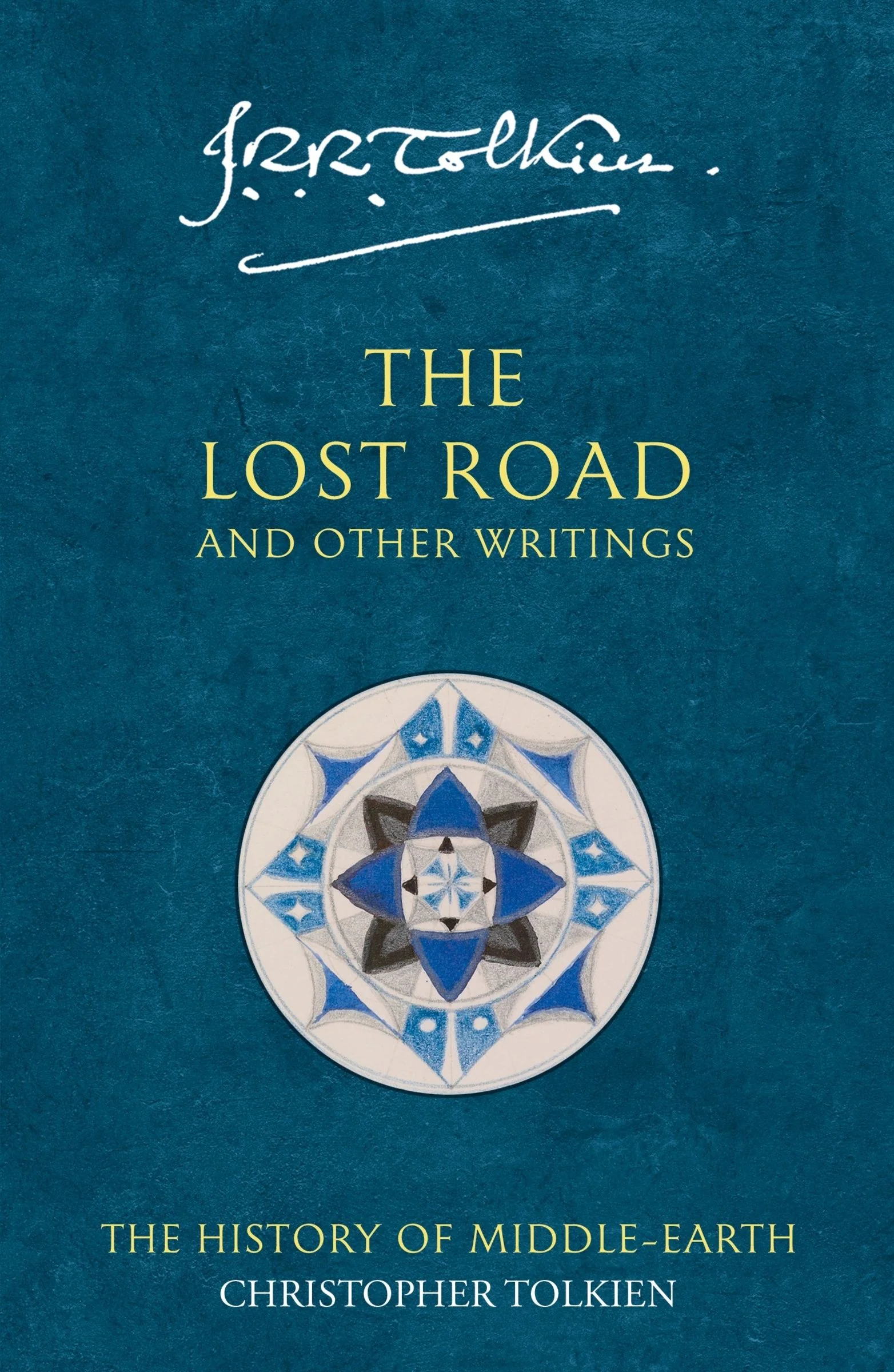
The Lost Road and Other Writings
The fifth volume of The History of Middle-earth, containing the early myths and legends which led to the writing of Tolkien’s epic tale of war, The Silmarillion.
At the end of 1937, J.R.R. Tolkien set aside his work on the myths and heroic legends of Valinor and Middle-earth and began The Lord of the Rings.
This fifth volume of The History of Middle-earth completes the examination of his writing up to that time. Later forms of “The Annals of Valinor” and “The Annals of Beleriand” had been composed, The Silmarillion was nearing completion in a greatly amplified form, and a new Map had been made. The legend of the Downfall of Númenor had entered the work, including those central ideas: the World Made Round and the Straight Path into the vanished West. Closely associated with this was the abandoned “time-travel” story “The Lost Road,” linking the world of Númenor and Middle-earth with the legends of many other times and peoples.
Also included in this volume is the “The Lhammas,” an essay on the complex languages and dialects of Middle-earth, and an etymological dictionary containing an extensive account of Elvish vocabularies.
The fifth volume of The History of Middle-earth, containing the early myths and legends which led to the writing of Tolkien’s epic tale of war, The Silmarillion.
At the end of 1937, J.R.R. Tolkien set aside his work on the myths and heroic legends of Valinor and Middle-earth and began The Lord of the Rings.
This fifth volume of The History of Middle-earth completes the examination of his writing up to that time. Later forms of “The Annals of Valinor” and “The Annals of Beleriand” had been composed, The Silmarillion was nearing completion in a greatly amplified form, and a new Map had been made. The legend of the Downfall of Númenor had entered the work, including those central ideas: the World Made Round and the Straight Path into the vanished West. Closely associated with this was the abandoned “time-travel” story “The Lost Road,” linking the world of Númenor and Middle-earth with the legends of many other times and peoples.
Also included in this volume is the “The Lhammas,” an essay on the complex languages and dialects of Middle-earth, and an etymological dictionary containing an extensive account of Elvish vocabularies.
Description
The fifth volume of The History of Middle-earth, containing the early myths and legends which led to the writing of Tolkien’s epic tale of war, The Silmarillion.
At the end of 1937, J.R.R. Tolkien set aside his work on the myths and heroic legends of Valinor and Middle-earth and began The Lord of the Rings.
This fifth volume of The History of Middle-earth completes the examination of his writing up to that time. Later forms of “The Annals of Valinor” and “The Annals of Beleriand” had been composed, The Silmarillion was nearing completion in a greatly amplified form, and a new Map had been made. The legend of the Downfall of Númenor had entered the work, including those central ideas: the World Made Round and the Straight Path into the vanished West. Closely associated with this was the abandoned “time-travel” story “The Lost Road,” linking the world of Númenor and Middle-earth with the legends of many other times and peoples.
Also included in this volume is the “The Lhammas,” an essay on the complex languages and dialects of Middle-earth, and an etymological dictionary containing an extensive account of Elvish vocabularies.